

Description
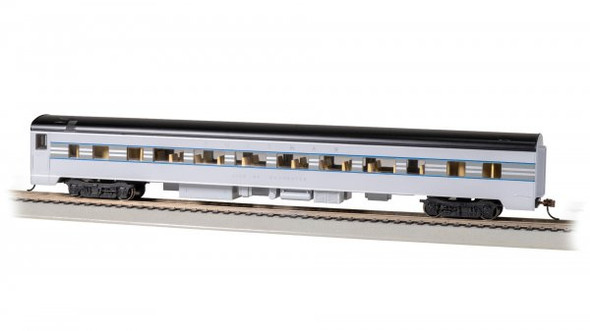
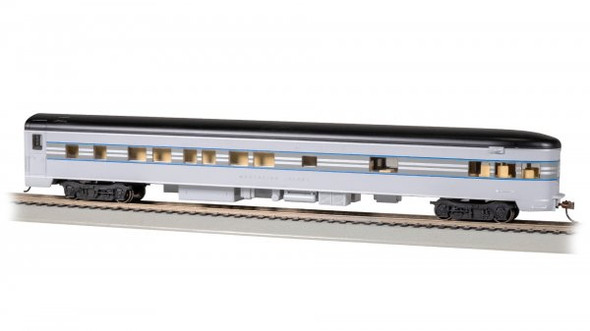
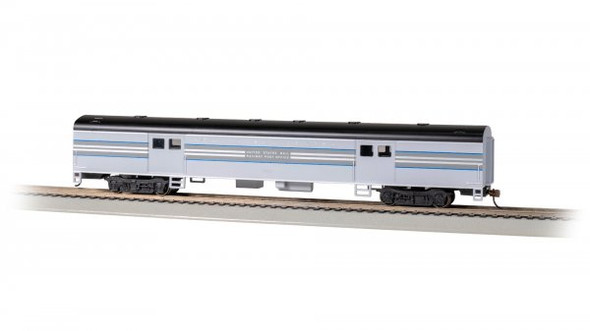
In the 1930s, new construction techniques allowed for the development of modern, lightweight passenger cars, departing from the heavy riveted steel or wooden-bodied designs found in previous decades. Materials such as stainless steel and aluminum reduced the overall weight of each car, making them more economical to construct and operate while allowing for ease of maintenance, a smoother ride, and improved durability over time. The smooth-side style was adopted by many railroads across North America for their high-priority streamlined express trains, lasting in common service until the mid-1970s. Today, smooth-side cars are frequently found on excursion trains, while some examples remain in revenue operation as commuter cars or corporate business cars.
Features Include
- Authentic ACF passenger car design
- LED interior lighting
- Transparent, tinted windows
- Fully furnished, detailed interiors
- Detailed, painted bodies with precision graphics
- Kinematic magnetically operated E-Z Mate® Mark II couplers, for operation on tight radius curves
- Detailed trucks with see-through sideframes
- Added weight for optimum tracking
- Blackened metal wheels with RP25 contours
- Performs best on 22” radius curves or greater
Details
Store Location: |
P# 130 / Aisle 6B |
Scale: |
HO Scale |
Road Name: |
New York Central (NYC) |
Road Number: |
"City Of Chicago" |
Customer Reviews
-
Bachmann Smooth-side cars
Let's start with the Pros. Paint is very good, Constant lighting is good, and they preform great even around 18R" curves. Now the Cons, Molded on details, No Kinematic couplers and Cost. Other notes, Drag is a bit more then a car without power pickups and about half the drag of the BLI passenger cars.