

Description
Pre-Order Due Date: TBA
_________
Pre-Order FAQ
Most manufacturers give an ETA on when they expect to release the pre-order which can be seen near the "add to cart" button on the product page. They also give an order due date (found in the product description) which is indicative of when the product is expected to go into production.
There is a 5% NON-refundable deposit for preorders, this amount will be deducted from the price of the product when it arrives. You will see how much downpayment is required after adding the item to your cart. We do not store your payment information and it is not charged by us when the product arrives.
For any pre-order submitted after the due date, we will try our best to fulfill your pre-order, but are at the mercy of the manufacturer and if they produce more than were preordered by their dealers. If we cannot fulfill your pre-order we will credit the 5% deposit to you.
When the pre-ordered product(s) are available to ship, you will receive an email requesting the remaining 95% payment that will take you to your cart. We will never charge your payment method without you checking out. At this time you are also able to add other in-stock items if you wish.
Please note that Estimated Arrival Dates can change at any point. Midwest Model Railroad is not responsible for manufacturers delaying production. Visit midwestmodelrr.com/pre-orders/ for more information.
_________


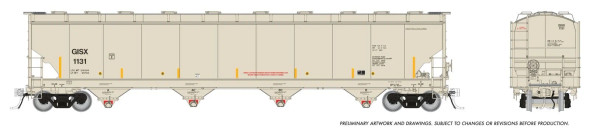
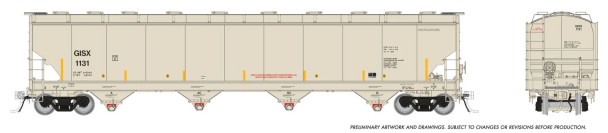
Introducing one of the most utterly common, unavoidable modern freight cars – the Trinity 6,221/6,241 cu. foot plastic pellet hopper. We challenge anyone to bring us an authoritative roster that truly includes every single one of these cars! We’ve been hard at work on data for both versions, and the early 6,221 cu. ft car alone has at least 10,000+ examples, while the later 6,241 cu. ft car, still in production today, far exceeds that total.
If you are wondering – what car, have I seen it before? We respond: have you seen a mixed freight go by since the year 1997? If you have, the answer is, yes have seen this car. Did you see a mixed freight go by today? The answer today is probably yes, with several of these cars in it.
Going back to the 1970’s, the first plastic pellet cars were built with more cubic capacity than grain cars to carry a lighter load. They’ve always been larger, with 4 bays instead of 3, and a greater overall length. A wide variety of car designs were built until the late 1990’s with capacity around 5,800 cubic feet. This includes all the plastic pellet car models you already have, with one exception, a model that came last came out 20 years ago.
But times have changed. Transporting plastic pellets has changed. These days, shippers want “high cube” 6,200 cu. ft cars to fill, and in the late 1990’s, railcar manufacturers updated all of their car designs to that standard. In Trinity’s case, they lengthened and expanded their previous 5,851 design, which had several interesting variations. The earliest version is “boxy”, with no cutout on the side like a covered hopper usually has, except for one spot where a grab iron is. Eventually that smaller cutout gets larger, and then becomes normal, with a curve signature to all Trinity covered hoppers.

Three of the four design variations of the Trinity 5,851 car. The final variation at the bottom has the design features of the 6,221 cu. ft. car at a smaller size.


From an angle, it is easy to see the boxy frame that is a design feature of all Trinity plastic pellet car designs, from the earliest 5,851 cu. ft. car in the 1980’s to a newly built car in 2026.
Beginning in 1997, Trinity begins to built a larger “high cube” 6,221 cu. ft design. It carries forward a signature feature all the way back from the earliest 1980’s 5,851 cars: a box-like frame around the entire carbody, with lip at each end above the coupler. To give a sense of how quickly high-cube 6,200 cu. ft. cars took over the market, the August 1999 edition of Freight Car Journal shows nearly 20,000 new cars built by all builders in the late 1990’s alone.
In the last 25 years, that number has only continued to grow. Trinity has slightly tweaked its design into a 6,241 cu. ft. model, which we will also offer. This car is still in production today! Plastic pellet cars are an excellent way to fill out a mixed freight or ad an industry to a layout. In our research, we found real examples of customers with 1-car spots with 1 single Trinity 6,241 on the siding – an industry you can squeeze into any layout!

An older 6,221 cu. ft. car with a fresh repaint.

A new build 6,241 cu. ft car.
Plastic pellet cars are an excellent way to fill out a mixed freight or ad an industry to a layout. In our research, we found real examples of customers with 1-car spots with 1 single Trinity 6,241 on the siding – an industry you can squeeze into any layout!
Trinity 6,221/6,241 Features:
-
Two overall carbody designs, 6,221 and 6,241
-
Multiple roof hatch styles and arrangements
-
Multiple outlet gate designs
-
Etched roof walks and end walkways
-
Spare hatches and different outlet gates included in polybag to let modeler modify for era
-
Separate grab irons installed at the factory
-
Full end cage details
-
Accurate paint and lettering
-
Multiple road numbers available for each scheme
-
Suggested minimum radius: 18”
-
Available as single car or six-packs unless noted

Customers for plastic pellet cars have many sizes, including both large facilities and single car shippers and receivers.
Details
Scale: |
HO Scale |
Road Name: |
GISX (INEOS Olefins & Polymers) |
Road Number: |
1131, 1182, 1200, 1212, 1328, 1388 |